Though penguins are the most well known, many species of birds call the Arctic and Antarctic home for at least part of the year. Many seabirds breed and raise their young in the polar regions during the summer months. Yet other species remain in the polar regions throughout the year. These birds utilize varied
behaviors, or actions that living things select or decide to do, to stay alive.
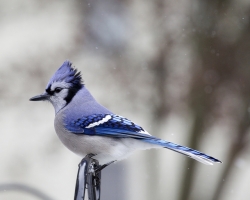
Blue jays are among several species of bird that do not migrate during the winter.
Dawn Huczek on Flickr.com
If you reside in a location with frigid, snowy winters, you know that January means piling on the layers, scarves, and gloves, and perhaps drinking a hot beverage. But how do birds that spend their winters in cold places stay warm? Packed into those birds are physical and behavioral adaptations to keep them provisioned throughout the year!
Behavioral adaptations are behaviors that living things have learned to do over a lengthy period of time that help them to stay alive and make babies.
First, birds' feathers provide a considerable amount of insulation.
Insulation is anything that is meant to prevent heat from transferring from one position to another. These birds work to keep heat from leaving their bodies. You might have noticed birds "fluffing up." They fluff their feathers to trap air amidst their feathers and bodies. The result is a natural layer of insulation, like a down sleeping bag. Also, when they sleep or unwind, the birds tuck their bills underneath their wing feathers in order to breathe in this warmer air.
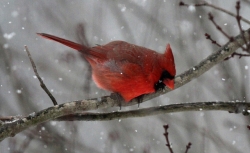
Does this cardinal look chubby? He's actually fluffing his feathers to trap air and stay warm!
fishhawk on Flickr.com
You may also notice many birds coming to your feeders when it is cold and snowy. Like mammals, birds are warm-blooded and have a high metabolic rate. In the winter especially, they must eat to keep their heart rate and be able to shiver to maintain their body temperature. As in humans, the shivering generates warmth.
While scarcely any birds have feathers on their feet to assist them in keeping toasty, countless birds have naked feet. Some birds stay warm by tucking one foot up underneath its feathers, balancing on merely one leg! In other birds, the way their blood flows in their feet aids keep the heat loss to a minimum while also preventing frostbite.
Concurrent blood exchange is when the warm blood that goes out to the feet flows next to the blood arriving back into the body from the feet and warms it up to come back into the body. If you've ever observed a duck swimming along on a partially frozen pond or a gull standing on ice, you may have speculated as to how its feet don't freeze. Those feet are not dense enough to have an insulating layer of fat, nor are they covered in feathers. The blood flows alongside to their skin, cooling rapidly in the freezing water. The dilemma for these birds is balancing the need to conserve body heat with the need to supply their legs and feet with suitable oxygen, nutrients, and warmth.
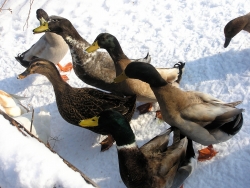
If these ducks were to hop into the frigid water, concurrent blood exchange would keep their feet from freezing.
liz west on Flickr.com
Birds also might change behaviors in the cold. Besides eating more, some huddle together for warmth. Birds such as snow grouse may hide in a snow burrow for shelter and warmth.
Finally, while many people think migration is a way for birds to "escape the cold," often the migration takes place to secure adequate food resources, rather than to just stay warm.
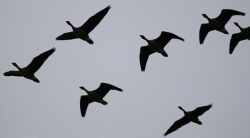
Birds who do migrate often do so because food is scarce in the winter and not just because of the cold.
nick goodrum at Flickr.com