There are many different kinds of living things. Even in one group, there are species that can look very different on the outside and inside from the other members of their group.  A species is a group of organisms who can have children with each other that will also be able to grow up and have children of their own.  In other words, your little brown dog and your friend's sizable white dog may look unique, but they are nevertheless all part of the same species because they are both dogs. Living things need to have children with the same species. They can't have children with a different species because they are too different from one other. At some point though, all organisms originated from the same relative; therefore, they all had to change somewhere along the way. Let's observe how these changes have transpired to make all of the different organisms on Earth. 
This organism is a member of a species, a group with DNA similar enough to reproduce and make offspring.
gailhampshire at Flickr.com


Speciation

Looking at all of the different kinds of organisms, we know there must have been a way for new living things to develop.  Speciation is the formation of two different groups from one original group that can no longer have children together. One species can be separated into two or more different places. This can make them change because of the different weather, food, or other kinds of living things they have to fight with to live. In order for new kinds of organisms to come about, two new groups must be formed from the first original group. Then each group would have to change so that they wouldn't be able to have children together.  One way this can occur is when geography separates a population from their parent population and, as a result, evolves differently. Biologists think of speciation as one original group splitting into two new groups. 
The diagram illustrates the relationship of elephants from its ancestral species.
Modified from Openstax Concepts of Biology


Geographic Isolation

A cluster of organisms doesn't always live in one small place together. They could live in one large place or they could live in a place that is divided by something, like a mountain or a body of water. Groups of living things that live in one large area are often alike in many ways. That is because of their gene flow, which is when different kinds of traits move around a group of the same kind of organism without limits. As long as the group can get around the location they live and have children with other living things in their species, flow can happen. Once a group is separated and the organisms in it can't get to each other, this can't occur. Imagine it like this: if there is a group of gray cats that live in the same town that can go anywhere, they would be able to reproduce and make more gray cats all over town. If the gray cats were separated from other cats and locked in a house, they wouldn't be capable of making more gray cats and would have stopped the gene flow for gray fur.  

If a group is split for a long time, each group may begin to change in different ways. Geographic isolation is when a group of identical types of living things is split up because of parts of the Earth that they can't navigate. This can be a mountain, a large lake or river, or another thing that severs a group. When this happens, the traits that everyone in the initial big group once had could change in unique ways within each group. Think of it like this: a huge wall is constructed in the middle of town. A cluster of cats on one side of town could begin to get better at jumping up trees to catch birds. There are no trees on the opposite side of the wall, so those cats need to get better at sneaking up on birds to catch them, instead of jumping. 
The northern spotted owl and the Mexican spotted owl inhabit geographically separate locations with different climates and ecosystems.
modification of work by John and Karen Hollingsworth, USFWS and Bill Radke, USFWS


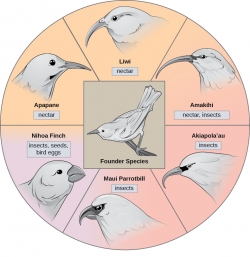
Also, when you separate an area, new conditions can pop up in the different areas. This can mean new types of weather, different areas to get food, different animals trying to eat each other, or different animals fighting for that same food and space. When this happens, only the living things that can live long enough to have children will be able to pass on their traits. Over time, the traits that led to living things dying will become extinct, too. Consider the cats we just discussed. The cats on the border of the wall with trees that couldn't jump to get the birds would perish because they wouldn't be able to get food. That means they wouldn't go on to make children that can't jump. The cats that could jump in the trees to get the birds would be able to go on and have children. They would pass on the ability to jump to their children, so in time, only cats that are good at jumping would be in that group. This is called divergent evolution, or when two kinds of organisms both originated from the same ancestor but changed over time because their environments changed. 
Divergent evolution: From one original species of bird, multiple others evolved, each with its own distinctive characteristics to suit its environment.
CNX OpenStax, CC BY 4.0 , via Wikimedia Commons


Let's also look at beetles as another example of this. Some beetles in this group are green and some are brown. Let's say the group was separated by a mountain. On one side of the mountain, there is a lot of rain and green plants can develop easily. This makes it easy for the green beetles to blend in and avoid getting eaten. The brown ones, however, get spotted and eaten up. On the other side of the mountain, the rain is blocked so the plants are brown and dry. On this side, the brown beetles blend in and the green ones are more likely to get eaten. Later, these two species will be totally diverged, or divided. Each group of beetles would be different from one another, but also unique from that first group of beetles that they all originated from. 

Given enough time, the divergence between one large group will likely cause changes to the way living things reproduce, which is how we mark the change from one species to two or more new groups. At some point, if living things in each of the two new groups were brought back together, mating would be less likely. However, if mating happened and each group was still somewhat alike, their children would not be able to have children of their own.

Darwin's Finches
Charles Darwin was one of the scientists that discovered that once a group is divided, each group changes in different ways over time.  Darwin spent time exploring the natural world on expeditions to the tropics. From 1831 to 1836, Darwin traveled around the world visiting South America, Australia, and the southern tip of Africa. Darwin's journey included stops at several island chains, the last being the Galapagos Islands. Darwin spent time on a group of islands and found that the living things on each island had a lot in common with each other, but were also clearly different. He saw this in the ground finches, a kind of bird, who had a beak shape that was different from the finches on another island.
Darwin observed that beak shape varies among finch species, and proposed that the beak of an ancestral species had adapted over time to help the finches to acquire different food sources.
John Gould (14.Sep.1804 - 3.Feb.1881), Public domain, via Wikimedia Commons


He observed both that these finches looked like other finch species on the mainland of South America and that the group of species in the Galapagos had many different beak sizes and shapes, with very small differences between the most similar.  Darwin imagined that the factions of birds on each island all initially came from the same group of birds, but diverged, or changed, into many different groups because the water on the island separated them. This meant they all had different food. On some of these new islands, there were a lot of hard seeds to eat. Only the birds with strong beaks would be able to crack open the seeds to get the food. They would be the ones to survive and have children and the birds with small beaks would die out. On another island, the food was found in tall flowers, which meant that the birds needed a long, thin beak to get food. On this island, the birds with short or fat beaks died out, while the birds with thin, long beaks went on to have children because they could get to the food. 

License

CC BY 4.0