Our Solar System
The solar system is made up of the Sun and many smaller objects: the planets, their moons, and "debris" such as comets, and dust. Decades of observation and space exploration have shown that most of these objects formed together with the Sun about 4.5 billion years ago. They are clumps of matter from a very big cloud of gas and dust that was pressed together to form them. The middle of this cloud became the Sun, and a small part of the matter in the outer parts, over time, formed the other objects that we will look at in this reading. During the past 50 years, we have learned more than we ever imagined!
Not only have we collected facts using powerful new telescopes, we have sent spacecraft right to many different places. We have flown past, orbited, or landed on every planet, returning pictures and data that have surprised both everyone. By doing this, we have also investigated hundreds of interesting moons, a dozen asteroids, and several comets. People have set foot on the Moon and returned samples of its soil for further study. We have even discovered other places in our solar system that might be able to have people, plants, and animals live there.
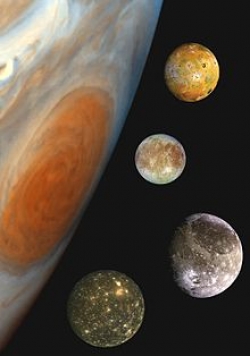
Jupiter's four Galilean moons are illustrated here. From top to bottom: Io, Europa, Ganymede, Callisto
NASA/JPL/DLR, Public domain, via Wikimedia Commons
Jupiter's Moons
A moon is a satellite that revolves around a planet. You are most likely familiar with Earth's own moon which can be seen most evenings in many shapes, based on where it is between to the Sun and the Earth. Did you know that many other planets in our solar system and further have one or more of their own moons? Perhaps the most important of these moons in our solar system are those around the planet Jupiter. Scientists have observed 69 moons to date, but the Galilean moons are the four largest moons that orbit Jupiter. They are named after the astronomer Galileo Galilei, who first saw these moons through his telescope in 1610. From 1996 to 1999, the Galileo spacecraft embarked on a complex but carefully planned path that provided frequent encounters with the large Galilean moons in order to gather as much data as possible. The four moons are called Io, Europa, Ganymede, and Callisto. We will talk about each of these four moons in greater detail.
Callisto
Callisto is Jupiter's outermost Galilean moon. It is made up of solid ice without a core or any layers. It is about 2 million kilometers away from Jupiter, and it ends its orbit of the planet every 17 days. Like our own Moon, this moon rotates in the same period as it revolves, so it always keeps the same face toward Jupiter. Its day is the same length of time as its month, 17 days. This moon has phases as seen from Jupiter, simply as we see our own moon as new, full or partial. Its noontime surface temperature, the warmest it will be at any point in its orbit, is only -140 degrees C, which means that water ice is stable on its surface year round, and it will not evaporate. This moon has a diameter of 4,820 kilometers, almost the same as the planet Mercury. Yet its mass is only one-third as great as Mercury, which means its density must be only one-third as great as well. This tells us that it has far less of the rocky and metallic materials found in the inner planets and must instead be an icy body through much of its interior, given that we know that ice is a solid which is much less dense than rock. This moon can show us how the geology of an icy object is alike or different from those with those made mostly of rock.
We can tell that it doesn't have a dense core from the details of its gravitational pull on the spacecraft. This shocked scientists, who expected that all the big icy moons would have a core. The surface is covered with impact craters, like the lunar highlands of our own moon. The fact that these are still here tells us that an icy object can hold onto impact craters on its surface. It is different from other planet-sized things that move around our Sun because it does not have a liquid layer inside. The layer on other planets, such as Earth, move heat and cause the surface to move around. Because it can't change in this way, we say it has been dead for a long time (moons are not alive, so by dead, we mean that it doesn't change) (Figure 1).
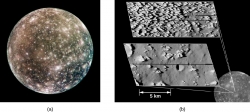
The bright spots on Callisto, Jupiter's outermost moon, are thought to be ice.
Ganymede, the Largest Moon
Ganymede is the largest moon in the solar system. It shows a great deal of cratering (Figure 2). The more craters, the longer the surface has been open to battering from space, and the older it must be. About one-quarter of its surface seems to be as old and heavily cratered as that of Callisto; the rest formed not too long ago, as we can tell by the few impact craters as well as the how new they are of those craters. If we judge from crater counts, this newer part of this moon is younger than our moon's lunar maria, likely 2 to 3 billion years old.
The differences between this moon and Callisto are more than skin deep. This moon has a core and other distinct layers. Studying its gravity as told us that the rock sank to form a core about the size of our Moon, with a mantle and crust of ice "floating" above it. Also, the spacecraft found that it has a magnetic field, which tells us it's inside it molten. Thus, it is not a dead world, but rather a place of intermittent geological activity powered by an internal heat source. In some places, the crust looks like it cracked, flooding many of the craters with water from the inside. Deep and far-reaching mountain ranges were formed by compression of the crust, forming long ridges with parallel valleys. In some places, older impact craters were split and pulled apart.
Why this moon so unique from Callisto? The difference in size and how it heats itself is one reason they could have developed differently over time. As on Earth, Jupiter has a gravitational effect on its closer moons, which causes tides or tidal pulls on Jupiter and these moons. It's close enough to Jupiter that the tidal forces theoretically could be heating the inside of the moon and causing many disturbances on its crust.
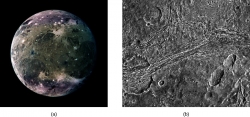
Ganymede is not only Jupiter's largest moon, but is the largest moon in the solar system.
Europa, a Moon with an Ocean
The inner two Galilean moons are not icy worlds like most of the moons of the outer planets. With densities and sizes like that of our Moon, they appear to be mostly rocky objects. How did they fail to get so much of the ice that must have been plentiful in the outer solar system at the time it was being formed? The most likely cause is Jupiter itself, which was hot enough to radiate a great deal of infrared energy during the first few million years after its when it was being formed. This infrared radiation would have heated the disk of matter near the planet that would over time join into the closer moons. As a result, any ice near Jupiter was vaporized, leaving the outer moons with compositions like that of planets in the inner solar system. Europa is Jupiter's moon with an ice-covered surface over an ocean and rocky land. In this, it looks like Earth, which has a layer of water on its surface, but for this moon, the water is capped by a thick crust of ice. There are very few impact craters in this ice, making it likely that the surface is in a constant state of geological self-renewal. Looking at the crater counts, the surface must be no more than a few million years old, and perhaps much less. When looking at impact craters, this moon is more geologically active than Earth.
The close-up pictures from the probe appear to confirm that there is an ocean (Figure 3). This moon has a frozen surface, but water underneath. This is like partially-frozen ice cubes, which you have likely taken a close look at to have a frozen surface and a liquid interior. In many places, the surface of this moon looks just as we would expect for a thick layer of ice that was broken up into giant icebergs and ice floes and then refrozen in place. When the ice breaks, water or slush from below may be able to seep up through the cracks and make the ridges and multiple-line features we see. The icy crust might change in thickness. This idea also looks to be true when you measure the small magnetic field through its interactions with Jupiter. The mark of this moon is that of a liquid water ocean, not one of ice or rock. If it really has a large ocean of liquid water under its ice, then it may be the only place in the solar system, other than Earth, with really large amounts of liquid water. To remain liquid, this ocean must be warmed by heat escaping from the interior of this moon. Is it possible that ecosystems like those on our earth could exist today under the ice of this moon? Many scientists now think that this moon is the most likely place in the solar system besides Earth on which to find life. So, NASA is designing a mission here to study this ocean and its ice crust and to identify locations where matter from inside has risen to the surface to see if there really is life here.
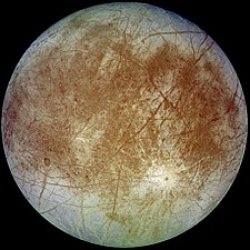
The darker regions on Europa show Europa's primarily water ice surface.
NASA/JPL/DLR, Public domain, via Wikimedia Commons
Io, a Volcanic Moon
Io is the innermost Galilean moon. It is in many ways a close twin of our Moon, with nearly the same size and density. We might think it is like the moon in other ways, too. What it looks like tells another story (Figure 4). Instead of being a dead cratered world, this moon turns out to have the highest level of volcanic activity in the solar system, far more than that of Earth. Its active volcanoes were discovered by the Voyager spacecraft. Eight volcanoes were seen erupting when it passed in March 1979, and six of these were still active four months later when another one passed. Many of the eruptions create graceful plumes that go very far out into space. The data shows that most of the eruptions here are made of hot lava, like the volcanoes on Earth. From time to time the hot lava meets frozen deposits of sulfur and sulfur dioxide. When these are suddenly heated, the result is great eruptive plumes far larger than any seen on earth. As they cool, they condense as solid particles that fall back to the surface in colorful "snowfalls" that extend very far from the vent. Maps of this moon reveal more than 100 recently active volcanoes.
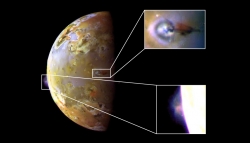
This close up shows two separate volcanic eruptions on Io.
References
Content adapted by the RocketLit team from:
OpenStax CNX. "The Galilean Moons of Jupiter - Astronomy" CNX.org, 2017.
https://cnx.org/contents/LnN76Opl@13.83:C_IbXlkV@3/The-Galilean-Moons-of-Jupiter